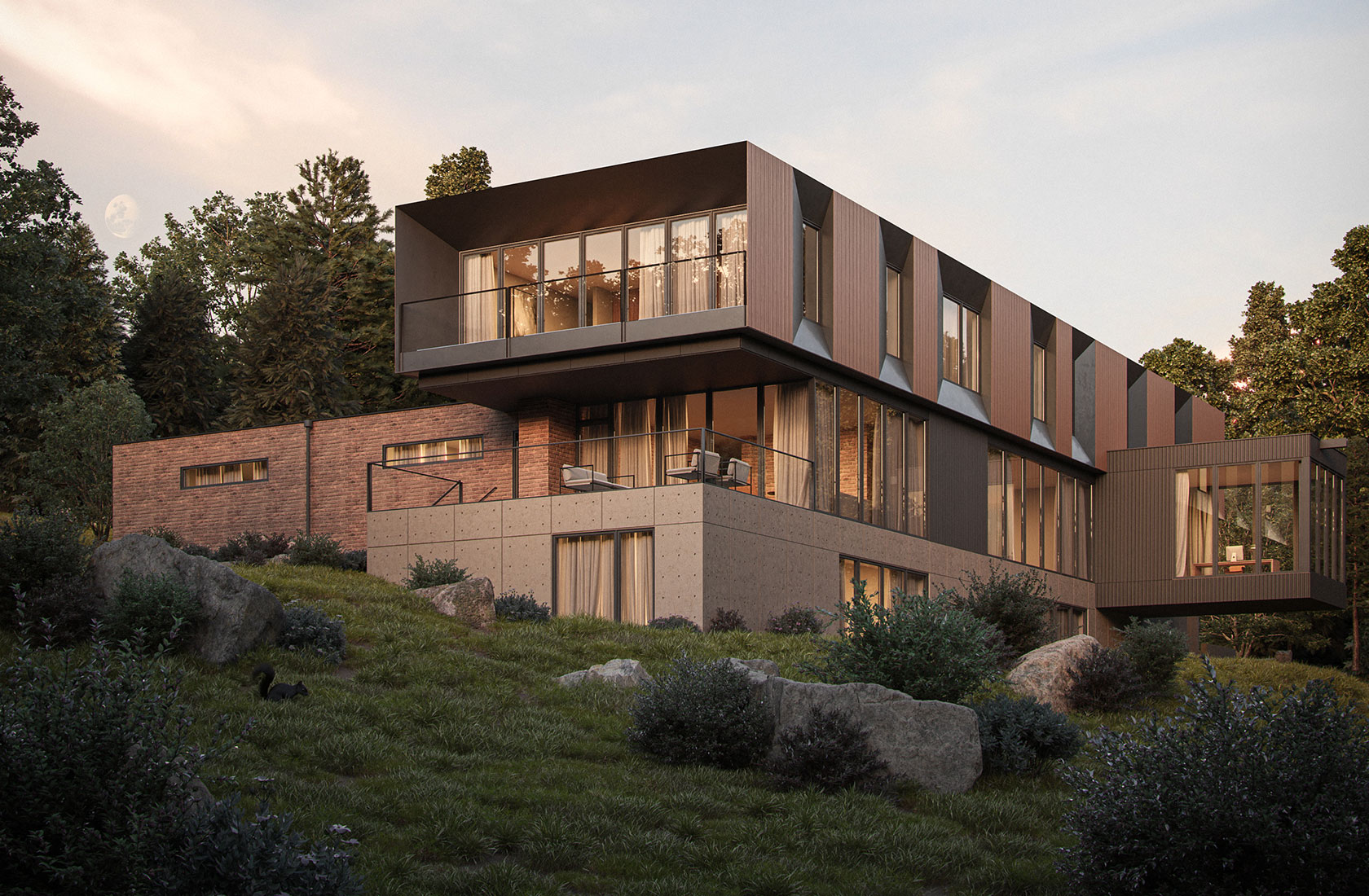
Building a custom home in Kelowna is not the same challenge as building in Vancouver or Calgary. The Okanagan's hillside topography, semi-arid climate, wildfire exposure, and lake-facing sites all create design conditions that are genuinely specific to the region. This post covers what you need to understand before starting a project in Kelowna or the broader Okanagan Valley.
Hillside sites and the Development Permit requirement
A significant proportion of desirable building land in Kelowna sits on slopes, and the city's Hillside Development Permit Area encompasses all properties where any portion of the lot has slopes exceeding 20 percent. A development permit addressing specific design guidelines must be obtained before building permits can be issued for these sites. The guidelines focus on minimizing cut and fill excavation, reducing the visual impact of retaining walls, preserving existing vegetation, and ensuring buildings are sited to minimize grading disruption.
Geotechnical reports are mandatory for all hillside permit applications in Kelowna, not only for slopes above 30 percent. A geotechnical engineer must confirm soil stability and slope safety, and their recommendations directly shape the foundation type and structural approach. On rocky hillside sites, this means engaging the geotechnical engineer early — before the architectural concept is fixed — so that foundation requirements do not force expensive late-stage redesigns.
The hillside requirement adds both time and cost to a project, but it also creates genuine architectural opportunity. A building that is thoughtfully sited on a slope, that steps with the terrain and creates different floor levels rather than flattening the site, will almost always be a more interesting and livable home than one designed for a flat lot and awkwardly imposed on the hillside. This is something we have seen consistently: the sites that seem most difficult to build on tend to produce the most compelling results when design is taken seriously.
Wildfire resilience
The 2023 McDougall Creek wildfire was a stark reminder that building in the Okanagan requires a serious approach to fire resilience. BC's wildfire interface zone designation affects many Kelowna-area properties, and FireSmart guidelines increasingly influence both material selection and site design.
Wildfire-resilient architecture is not only about material choices, though those matter significantly. Non-combustible cladding systems, metal roofing, and protected eave soffits reduce ignition risk from ember transport — the primary mechanism by which homes in interface zones are lost. Site design also plays a role: defensible space around the building, firebreak landscaping, and the placement of decks and combustible elements relative to prevailing wind directions are all design decisions with real fire resilience implications.
Our approach to material selection in Calgary's extreme climate translates directly to the Okanagan's fire interface context. Both environments reward material choices that perform reliably over decades rather than looking good at handover. Timelessness and durability are not separate from good design. They are part of it.
Passive design and the Okanagan climate
The Okanagan has one of Canada's most variable climates for a residential market. Summers regularly exceed 35 degrees Celsius. Winters bring genuine cold. Diurnal temperature swings in spring and fall are dramatic. A home that ignores passive design principles here will be uncomfortable and expensive to operate, and one of our consistent tenets across every project we design is natural ventilation — a well-ventilated home is a healthy one, and should rely as little as possible on cooling equipment.
Passive solar design in Kelowna means orienting main living spaces and primary glazing to the south, using roof overhangs sized to admit low winter sun while shading summer sun at its higher angle, and providing thermal mass to moderate temperature swings. These principles are not expensive to incorporate at the design stage. They are, however, frequently overlooked in production homes where the plan is generated without reference to the specific site's orientation. BC's Energy Step Code requires an energy compliance report from a certified advisor at permit submission for new residential construction. A genuinely passive-oriented custom home should exceed that standard comfortably while also being more pleasant and affordable to live in.
The hillside lot that seems most challenging to build on is often the site that produces the most compelling home. Difficulty is not a reason to avoid a site. It is a reason to take the design seriously.
The Kelowna permit process
The City of Kelowna targets a four to six week review timeline from complete application for straightforward single-family homes. Hillside Development Permit applications run in parallel with or ahead of the building permit, adding time depending on site complexity and whether variances are required. The application must include architectural drawings, structural drawings with Letters of Assurance, a current title search, and the energy compliance report. Geotechnical reports must accompany applications for hillside sites.
As with any permit process, the most effective way to manage timelines is to submit a complete application the first time. Deficiency responses reset the review clock. An architect who prepares permit packages with Kelowna's specific checklist requirements in mind, and who has submitted to the city before, will reduce the back-and-forth that adds weeks to the process.